IoT Intelligent Camera
IoT has taken the world by storm and is only continuing to grow in popularity. With more and more devices coming online every day, the need for robust and reliable communication infrastructure is essential. Fortunately, ESP32 provides everything needed to easily create reliable, scalable IoT applications. It’s no wonder then that it has become one of the most popular microcontrollers for IoT development. In this blog post, we will take a closer look at some of the features that make ESP32 so well-suited.
The rise of the internet of things has brought with it a new category of devices: the intelligent camera. These are devices that, once connected to the internet, can be controlled and monitored from a distance.
One of the most popular uses for intelligent cameras is home security. With a smart camera, you can keep an eye on your home from anywhere in the world. You can also use them to monitor your pets or babysit your children.
Intelligent cameras can also be used for business purposes. For example, you can use them to keep an eye on your employees or to monitor your factory floor.
IoT Components
The Internet of Things (IoT) is a network of interconnected devices and objects that can communicate with each other. These devices can be anything from door locks to refrigerators, and they can relay information back and forth between each other to create a smart, interconnected network. By 2020, it’s estimated that there will be more than 20 billion IoT devices in use worldwide. This number is projected to grow as businesses and consumers alike begin to see the value in interconnectedness.
There are some main components of IoT:
ESP32
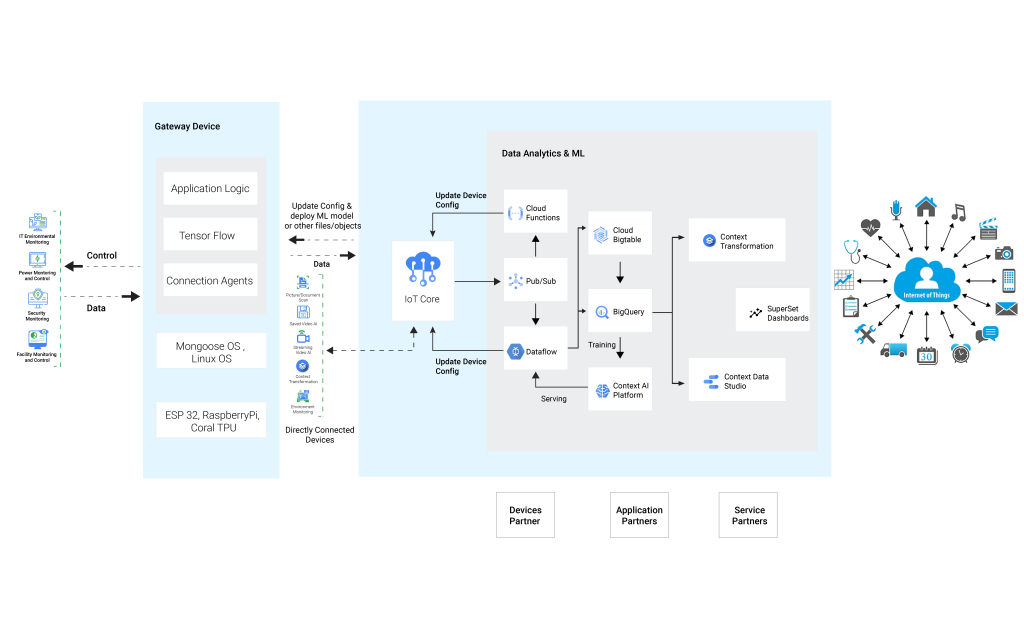
Sensors are devices that measure and collect data from the surrounding environment. Esp32 controllers are microcontrollers that can be used to read and control these sensors. In this tutorial, we will connect a motion sensor, a temperature and humidity sensor, and a voltage and current sensor to our Esp32 controller.
The data of these sensors are published through mqtt protocol to cloud IoT core device.
ESP32 Cam has in built camera module which can take images and stream live videos. These media files can be transfer to the google cloud IoT core through pubsub.
Cloud IOT Core Device
The Cloud IoT Core Device is a secure and scalable way to manage your internet of things devices. It was designed for large-scale deployments and helps you to connect, monitor, and manage your devices securely and efficiently. You can use the Cloud IoT Core Device to connect your devices to the cloud, collect and process data, and take action based on that data.
The device manager lets you create and configure device registries and the devices within them.
A device can be blocked from communicating with Cloud IoT Core. This can be useful when a sensor fails or a device is misconfigured.
The device registry is configured with one or more Cloud Pub/Sub topics to which telemetry events are published for all devices in that registry. A single topic can be used to collect data across all regions.
Vision AI
The Vision AI will be helpful in identifying the objects that exist in our media files coming from esp32 through pub sub.
Vision AI is an artificial intelligence system that can interpret and understand the visual world. It does this by extracting information from images and videos, and then using that information to identify and track objects, people, and other features.
Dataflow
Dataflow pipeline will insert the all of our data (data of sensors , images , videos , audios or vision AI result) into our bigQuery and store it as a file in cloud storage.
We can use superset or data studio to visualize these data in our dashboard.
ContexAI Platform
We can use our ContextAI platform to define different type of workflows for our IoT Application.
IoT workflows will enable the users to get a view of the state of the business processes in real time.
It will enable the business to take action based on the data made available.
Data about the business process and alerts can be stored and mined to derive insights
Mobile Application
We can control the state of our device.
We can monitor the real time data and also visualize the data in different charts.
We can view the media files (videos or images) using our mobile application.
IoT Intelligent Camera Features:
Cloud Storage
Our IoT Device is able to record normal videos and can store it locally or in cloud storage as per user requirement.
Screenshots at Specified Interval
Our IoT Device is able to take screenshots at specified interval and perform vision AI (Google API) on that picture. And the result of Vision AI will be stored in bigQuery for Later analytics.
Motion Detection
Our IoT Device has in built motion detection sensor which will help in optimizing the usage of cloud resources.
Inbuilt Temperature Sensor
Our IoT Device has inbuilt temperature & humidity sensor which will continuously log our current environment temperature in cloud.
Mobile App
We can control our Iot Device using our mobile application. For example turning the flash light on and off.
Workflow
We can define our workflow in our web application. Using this we can define the custom triggers which will notify us based on real events. Let say we want alert whenever any person enter in our room at night during 1:00 am to 5:00 am.
This article discussed the usefulness of IoT intelligent cameras and how they can help businesses improve their security. The article also provided a link to follow us so that you can stay up-to-date on the latest in IoT intelligent camera technology.